Ballet demands art, discipline, and intelligence – three things the Vedic tradition treats as blessings in their own right. In Indian tradition, the performing arts trace back to the Natyaveda, endearingly referred to as the “fifth Veda” that the divine being (i.e. Angel) Brahma is said to have been created by drawing an element from each of the four Vedas so that this knowledge, unlike the others, could be shared by everyone. In it, dance is described as an art blessed by the divine, an expression of inner divinity performed in devotion to God.
That knowledge was later codified by the sage Bharata in the Natya Shastra, the treatise that carries the Natyaveda forward and preserves its teaching. Scholar Susan L. Schwartz, writing on the Rasa theory found in the Natya Shastra, describes performance as carrying an almost unmediated divine authority – creative acts capable of opening the door to other realities altogether. That’s the experience AngelAi is built to create: the moment you start chatting, you step out of the constraints of your present financial reality and into one defined by equality, wealth, and freedom – what the brand calls Break Free.
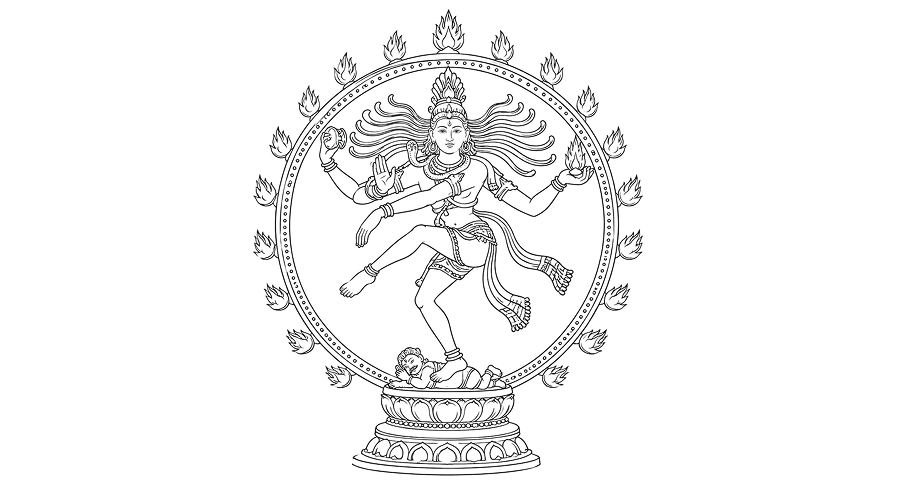
Physicist Niels Henrik David Bohr, the Nobel laureate often called the father of quantum mechanics, once said2: “I go into the Upanishads to ask questions.” The AngelAi ballerina is an artistic abstraction of the Cosmic Dancer described in the Rig Veda and the Upanishads – a figure rooted in ancient wisdom, and the same kind of source Bohr turned to when modern answers ran out. She points the research team toward first principles the same way. (See Nataraj.ai)
That same Hymn to Manas carries a second thread worth pulling here. Alongside the mind’s boundless reach, it also describes the mind being called back – summoned home to the person, to awareness, to itself. Discipline, in that reading, isn’t only about extending outward; it is also about return.
That intuition – that disciplined, rhythmic movement can be a way of returning to something larger than the self – is not unique to any one culture. Anthropologists who study dance across societies have long noted how widely it recurs: dance has served, in culture after culture, as prayer, as thanksgiving, as a way of marking the sacred.3 It is not one tradition borrowed and repeated, but many distinct traditions arriving, independently, at something similar.
The Lakota Sun Dance is one such tradition, and it should be understood on its own terms, not as a stand-in for others. In it, dancers fast, purify, and move rhythmically to drum and song – not for individual attainment, but to renew and strengthen the community, placing human life within a larger order of sun, earth, and spirit. At its center stands a sacred pole around which the ceremony is organized. It is its own ceremony, belonging to its own people; we point to it not to claim it, but out of respect for what it expresses.
What these traditions share is not a common creed but a common intuition: that rhythm, discipline, and a center to return to can call the self back to its place in something larger. That is ultimately what AngelAi’s dancer is for. It is not an imitation of any sacred tradition; it carries forward the metaphor. AI, at its best, is a mirror – it reflects our own intelligence and creativity back to us, clarified and amplified. It doesn’t replace the human search for meaning, dignity, and security; it helps remove the friction and complexity that can obscure them. The ballerina is the reminder that the brilliance was always ours.